Donoghue v Stevenson Case Summary
A concise case summary of Donoghue v Stevenson, including the facts, the absence of a contractual claim and the House of Lords’ duty-of-care decision.

Key takeaways
- Mrs Donoghue had no contractual claim against the manufacturer because her friend bought the drink.
- The House of Lords recognised a duty of care owed by manufacturers to ultimate consumers.
- The neighbour principle became a foundation of the modern law of negligence.
GET OUR HELP
Donoghue v Stevenson** (1932) AC 562, UKHL 100**
FACTS
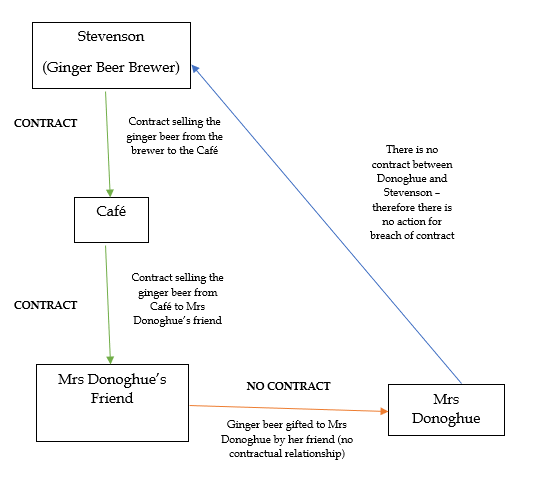
– The Plaintiff (or Claimant as they are now called), Mrs Donoghue drank from a bottle of ginger beer. This was bought to her by a friend in a café.
– The bottle was opaque and when she poured the contents into her glass, she noticed a decomposed snail in the bottom.
– The snail allegedly caused her to become sick.
– Mrs Donoghue did** not hold a contract** with the beer manufacturer, so the only way she could seek legal redress was through the tort of negligence.
Looking to improve your law essay grades? LexIQ’s AI Essay Marker provides detailed line-by-line feedback, paragraph rewrites, and a first-class model answer outline in just 60 seconds. Plans from £14.99/month. Try it now →

The below diagram illustrates the contractual relationship in the case – note that Donoghue did not have a contract with Stevenson, therefore the action was in negligence rather than breach of contract.
DECISION
– The House of Lords (as it then was) held that the manufacturer (Stevenson – the Defendant) owed Mrs. Donoghue a duty of care not to cause her injury. This is sometimes referred to establishing the ‘neighbourhood principle’.
– Three main reasonings of the court:
-
Negligence is a distinct and separate element of tort law
-
Duty of care in tort does not require a contractual relationship
-
Manufacturers of a product owe a duty to those who intend to use their product
GET OUR HELP
Want Expert Feedback on Your Law Essays?
LexIQ’s AI Essay Marker gives you line-by-line feedback, paragraph rewrites, a predicted grade, and a first-class model answer outline — all in 60 seconds. Designed by a practicing barrister and covering all UK law modules. Plans start from just £14.99/month.
Get Your Law Essay Marked Now
Preparing for the SQE? Start Practising Smarter.
LexIQ’s SQE Preparation Course offers AI-powered practice questions, timed mock exams, and personalised analytics across all 14 FLK areas — built for the SRA’s SQE1 Assessment Specification. Over 5,000 practice questions and full 180-question mock exams. Plans start from just £34.99/month.
Start Your SQE Preparation Now
About the author
Keane Davison
Keane is a barrister and the founder of The Law Tutors, with a focus on helping students at every stage of legal education and practice.